

Square Of A Difference Formula
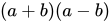
In mathematics, the difference of two squares is a squared (multiplied past itself) number subtracted from another squared number. Every difference of squares may exist factored according to the identity

in uncomplicated algebra.
Proof [edit]
The proof of the factorization identity is straightforward. Starting from the left-mitt side, use the distributive law to get

By the commutative police, the center two terms cancel:

leaving

The resulting identity is one of the most commonly used in mathematics. Among many uses, it gives a simple proof of the AM–GM inequality in two variables.
The proof holds in whatsoever commutative ring.
Conversely, if this identity holds in a ring R for all pairs of elements a and b, so R is commutative. To see this, employ the distributive law to the correct-hand side of the equation and get
- .

For this to be equal to , we must have

for all pairs a, b, and so R is commutative.
Geometrical demonstrations [edit]

The difference of ii squares tin too exist illustrated geometrically as the difference of two square areas in a plane. In the diagram, the shaded part represents the difference between the areas of the 2 squares, i.e. . The surface area of the shaded part can be found by adding the areas of the two rectangles; , which tin exist factorized to . Therefore, .

Another geometric proof gain equally follows: Nosotros start with the effigy shown in the first diagram beneath, a large foursquare with a smaller square removed from it. The side of the entire square is a, and the side of the pocket-sized removed square is b. The expanse of the shaded region is . A cut is made, splitting the region into two rectangular pieces, every bit shown in the second diagram. The larger piece, at the top, has width a and height a-b. The smaller slice, at the bottom, has width a-b and height b. At present the smaller piece can exist discrete, rotated, and placed to the right of the larger slice. In this new system, shown in the last diagram below, the two pieces together form a rectangle, whose width is and whose height is . This rectangle's expanse is . Since this rectangle came from rearranging the original figure, information technology must have the same area as the original figure. Therefore, . 


Uses [edit]
Factorization of polynomials and simplification of expressions [edit]
The formula for the divergence of ii squares can be used for factoring polynomials that contain the square of a commencement quantity minus the square of a second quantity. For instance, the polynomial can be factored as follows:


As a 2nd instance, the first ii terms of can exist factored as , and then nosotros accept:

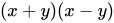

Moreover, this formula can also be used for simplifying expressions:

Complex number instance: sum of two squares [edit]
The difference of two squares is used to detect the linear factors of the sum of 2 squares, using circuitous number coefficients.
For example, the complex roots of can be establish using difference of two squares:

- (since )



Therefore, the linear factors are and .


Since the two factors found by this method are complex conjugates, nosotros can use this in contrary as a method of multiplying a circuitous number to get a existent number. This is used to get real denominators in complex fractions.[ane]
Rationalising denominators [edit]
The divergence of ii squares can also be used in the rationalising of irrational denominators.[ii] This is a method for removing surds from expressions (or at least moving them), applying to division by some combinations involving square roots.
For example: The denominator of can be rationalised as follows:


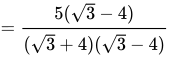
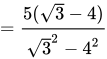
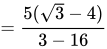
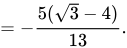
Hither, the irrational denominator has been rationalised to .


Mental arithmetics [edit]
The difference of 2 squares tin besides be used every bit an arithmetical brusque cut. If 2 numbers (whose average is a number which is easily squared) are multiplied, the difference of two squares tin be used to give you the product of the original ii numbers.
For example:

Using the difference of two squares, can be restated equally

- which is .

Difference of 2 consecutive perfect squares [edit]
The departure of ii consecutive perfect squares is the sum of the two bases north and n+1. This can exist seen equally follows:

Therefore, the difference of two consecutive perfect squares is an odd number. Similarly, the divergence of two capricious perfect squares is calculated as follows:

Therefore, the difference of two fifty-fifty perfect squares is a multiple of four and the departure of 2 odd perfect squares is a multiple of eight.
Factorization of integers [edit]
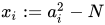
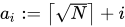
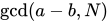
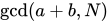
Several algorithms in number theory and cryptography use differences of squares to detect factors of integers and detect composite numbers. A simple case is the Fermat factorization method, which considers the sequence of numbers , for . If one of the equals a perfect square , then is a (potentially not-piffling) factorization of .




This trick can exist generalized as follows. If mod and modern , and so is composite with non-petty factors and . This forms the basis of several factorization algorithms (such as the quadratic sieve) and can be combined with the Fermat primality exam to give the stronger Miller–Rabin primality test.


Generalizations [edit]

Vectors a (regal), b (cyan) and a + b (blue) are shown with arrows
The identity likewise holds in inner product spaces over the field of existent numbers, such every bit for dot product of Euclidean vectors:

The proof is identical. For the special case that a and b accept equal norms (which means that their dot squares are equal), this demonstrates analytically the fact that two diagonals of a rhomb are perpendicular. This follows from the left side of the equation being equal to zero, requiring the right side to equal zero equally well, and so the vector sum of a + b (the long diagonal of the rhombus) dotted with the vector difference a - b (the short diagonal of the rhombus) must equal zero, which indicates the diagonals are perpendicular.
Difference of two nth powers [edit]
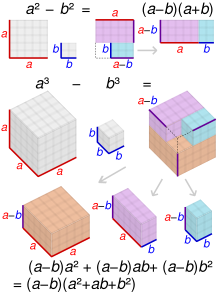
Visual proof of the differences between 2 squares and two cubes
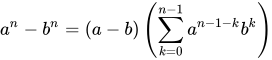
If a and b are two elements of a commutative band R, and then .
History [edit]
Historically, the Babylonians used the difference of 2 squares to calculate multiplications. [3]
For example:
93 ten 87 = xc² - 3² = 8091
64 x 56 = 60² - 4² = 3584
Meet likewise [edit]
- Congruum, the shared deviation of iii squares in arithmetics progression
- Conjugate (algebra)
- Factorization
Notes [edit]
- ^ Complex or imaginary numbers TheMathPage.com, retrieved 22 December 2011
- ^ Multiplying Radicals TheMathPage.com, retrieved 22 Dec 2011
- ^ "Babylonian mathematics".
References [edit]
- Stanton, James Stuart (2005). Encyclopedia of Mathematics. Infobase Publishing. p. 131. ISBN0-8160-5124-0.
- Tussy, Alan S.; Gustafson, Roy David (2011). Elementary Algebra (5th ed.). Cengage Learning. pp. 467–469. ISBN978-1-111-56766-8.
External links [edit]
- divergence of 2 squares at mathpages.com

Square Of A Difference Formula,
Source: https://en.wikipedia.org/wiki/Difference_of_two_squares
Posted by: dewittnaal1948.blogspot.com
0 Response to "Square Of A Difference Formula"
Post a Comment