

Why Does Iago Hate Othello

 The Tragedy of Othello, the Moor of Venice really opens with Iago and Roderigo discussing this exact subject, though the audience does non yet realize the bailiwick of their chat:
Roderigo. Chiliad told'st me k didst hold him in thy hate.
Iago. Despise me, if I practise not.
Iago goes on to offer several reasons why he hates this person, whoever this person is.
…3 bang-up ones of the city,
In personal suit to make me his lieutenant,
Off-capp'd to him: …and, by the faith of man,
I know my toll, I am worth no worse a place:
But he; as loving his ain pride and purposes,
Evades them, with a bombast circumstance
Horribly stuff'd with epithets of state of war;
And, in determination,
Nonsuits my mediators; for, 'Certes,' says he,
'I accept already chose my officer.'
And what was he?
Forsooth, a great arithmetician,
One Michael Cassio, a Florentine,
A fellow almost damn'd in a fair wife;
That never prepare a squadron in the field,
Nor the partitioning of a battle knows
More than a spinster; unless the bookish theoric,
Wherein the toged consuls can suggest
As masterly every bit he: mere prattle, without practise,
Is all his soldiership. But he, sir, had the election:
And I, of whom his optics had seen the proof
At Rhodes, at Cyprus and on other grounds
Christian and heathen, must be exist-lee'd and calm'd
Past debitor and creditor: this counter-pulley,
He, in skilful time, must his lieutenant be,
And I—God bless the mark!—his Moorship'southward ancient.
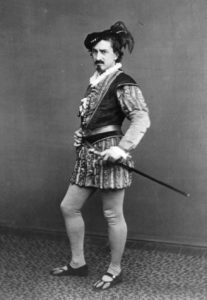 What does that all mean? Iago was lobbying for the lieutenant'southward position under Othello ("his Moorship") and even had some high-powered citizens/politicians ("great ones of the urban center") get and offer their personal recommendation, only to find that Othello had already chosen Michael Cassio. Iago is not happy with this decision, and has zilch good to say of Cassio, who has no boxing experience (as Iago does), and is instead what today might be called "book smart."
Merely! Is this the real reason? Or is this just the reason that Iago is feeding Roderigo? At the close of Deed 1, solitary on stage, Iago reveals a deeper reason for his hatred:
…I hate the Moor:
And it is idea abroad, that 'twixt my sheets
He has done my office: I know not if't exist true;
But I, for mere suspicion in that kind,
Will do equally if for surety.
"Twixt my sheets washed my office" is a polite way of maxim, "Slept with my married woman." Iago even admits to non knowing if it is true, only doesn't care.
Then, again, is this the reason? Or is this again some other justification for something deeper? This sounds more like he's preparing an alibi, in case he ultimately needs one.
Does it go back to the racist thing? Maybe Iago doesn't fifty-fifty want the lieutenant's job, perchance he'south furious that Othello is in charge at all? He'southward not shy almost hurling racial epithets at Desdemona's father in Human activity i, Scene 1:
Iago. 'Zounds, sir, you're robb'd; for shame, put on
your gown;
Your heart is burst, y'all take lost half your soul;
Fifty-fifty now, at present, very at present, an old black ram
Is topping your white ewe. Arise, arise;
Awake the snorting citizens with the bell,
Or else the devil will make a grandsire of you:
Arise, I say.…Because we come to
practice you service and you think we are ruffians, you'll
have your daughter covered with a Barbary horse;
you'll have your nephews neigh to you; you'll have
coursers for cousins and gennets for germans.
Twice he refers to Othello as an animal (along with the associated suggestions of bestiality) and in one case equally the devil.
But, once again – perchance he's but saying these things because he knows that they will upset Desdemona's male parent Brabantio?
Maybe it's none of these things. Maybe Iago is a sociopath who truly has no specific reason for his hatred of Othello. That'south what makes this graphic symbol ane of Shakespeare'southward greatest creations. Every thespian must decide for himself the source of Iago's motivation. Peradventure we tin can never truly know considering there just isn't a single right respond.

Why Does Iago Hate Othello,
Source: https://www.shakespearegeek.com/2015/01/why-does-iago-hate-othello.html
Posted by: dewittnaal1948.blogspot.com
0 Response to "Why Does Iago Hate Othello"
Post a Comment