

Mass Entertainment In The 1920s
The Jazz Historic period: Redefining the Nation, 1919-1929
Prosperity and the Production of Popular Entertainment
OpenStaxCollege
[latexpage]
Learning Objectives
Past the stop of this department, you lot will be able to:
- Discuss the role of movies in the evolution of American culture
- Explain the rise of sports as a dominant social forcefulness
- Analyze the ways in which the automobile, specially the Model T, transformed American life
In the 1920s, prosperity manifested itself in many forms, most notably in advancements in entertainment and technology that led to new patterns of leisure and consumption. Movies and sports became increasingly popular and buying on credit or "conveying" the debt immune for the sale of more consumer goods and put automobiles within reach of average Americans. Advertising became a primal institution in this new consumer economy, and commercial radio and magazines turned athletes and actors into national icons.
MOVIES
The increased prosperity of the 1920s gave many Americans more than disposable income to spend on entertainment. As the popularity of "moving pictures" grew in the early office of the decade, "pic palaces," capable of seating thousands, sprang up in major cities. A ticket for a double characteristic and a live bear witness price twenty-v cents; for a quarter, Americans could escape from their issues and lose themselves in some other era or earth. People of all ages attended the movies with far more than regularity than today, frequently going more than one time per calendar week. Past the end of the decade, weekly picture attendance swelled to ninety meg people.
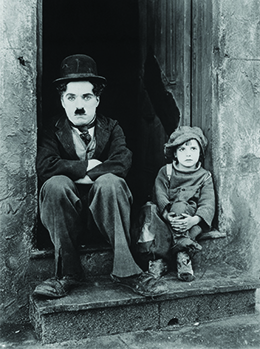
The silent movies of the early on 1920s gave rise to the first generation of movie stars. Rudolph Valentino, the lothario with the bedroom eyes, and Clara Bow, the "It Girl" with sex entreatment, filled the imagination of millions of American moviegoers. Nevertheless, no star captured the attention of the American viewing public more than Charlie Chaplin. This sad-eyed tramp with a moustache, baggy pants, and a pikestaff was the top box office attraction of his fourth dimension ([link]).
Charlie Chaplin's nickname "The Tramp" came from the recurring graphic symbol he played in many of his silent films, such as 1921's The Kid, which starred Jackie Coogan in the title office.
In 1927, the world of the silent picture began to wane with the New York release of the first "talkie": The Jazz Singer. The plot of this flick, which starred Al Jolson, told a distinctively American story of the 1920s. Information technology follows the life of a Jewish man from his boyhood days of being clean-cut to be the cantor at the local synagogue to his life as a famous and "Americanized" jazz singer. Both the story and the new sound applied science used to nowadays it were popular with audiences around the land. It quickly became a huge hit for Warner Brothers, one of the "big five" movement flick studios in Hollywood forth with Twentieth Century Fox, RKO Pictures, Paramount Pictures, and Metro-Goldwyn-Mayer.
Southern California in the 1920s, however, had only recently become the middle of the American film industry. Film production was originally based in and around New York, where Thomas Edison first debuted the kinetoscope in 1893. But in the 1910s, equally major filmmakers like D. W. Griffith looked to escape the price of Edison'southward patents on camera equipment, this began to change. When Griffith filmed In Former California (1910), the first movie always shot in Hollywood, California, the small town north of Los Angeles was little more than a hamlet. Equally moviemakers flocked to southern California, not least considering of its favorable climate and predictable sunshine, Hollywood swelled with moviemaking activity. By the 1920s, the in one case-sleepy village was domicile to a majorly profitable innovative industry in the United states of america.
AUTOMOBILES AND AIRPLANES: AMERICANS ON THE Movement
Movie theatre was not the only major manufacture to make great technological strides in this decade. The 1920s opened up new possibilities of mobility for a large pct of the U.Southward. population, every bit automobile manufacturers began to mass produce what had once been a luxury particular, and daring aviators both demonstrated and collection advancements in aircraft engineering science. The virtually significant innovation of this era was Henry Ford'southward Model T Ford, which made machine ownership bachelor to the average American.
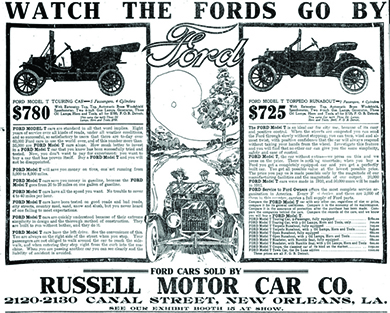
Ford did non invent the automobile—the Duryea brothers in Massachusetts besides as Gottlieb West. Daimler and Karl Friedrich Benz in Germany were early pioneers. By the early twentieth century, hundreds of car manufacturers existed. However, they all fabricated products that were too expensive for most Americans. Ford's innovation lay in his focus on using mass production to industry automobiles; he revolutionized industrial work by perfecting the associates line, which enabled him to lower the Model T's price from $850 in 1908 to $300 in 1924, making auto ownership a real possibility for a large share of the population ([link]). As prices dropped, more than and more people could beget to own a car. Shortly, people could buy used Model Ts for equally little as five dollars, assuasive students and others with low incomes to enjoy the freedom and mobility of machine ownership. By 1929, there were over twenty-iii million automobiles on American roads.
This ad for Ford'southward Model T ran in the New Orleans Times Fiddling in 1911. Note that the prices have not yet dropped far from their initial high of $850.
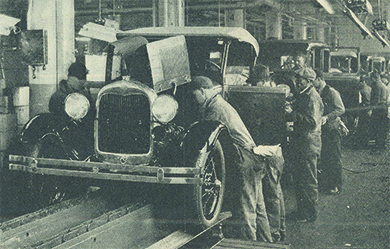
The assembly line helped Ford reduce labor costs within the product process by moving the product from one squad of workers to the next, each of them completing a stride so elementary they had to be, in Ford'southward words, "no smarter than an ox" ([link]). Ford'southward reliance on the moving assembly line, scientific direction, and time-motion studies added to his emphasis on efficiency over craftsmanship.
In this epitome from a 1928 Literary Digest interview with Henry Ford, workers on an assembly line produce new models of Ford automobiles.
Ford's accent on cheap mass product brought both benefits and disadvantages to its workers. Ford would not allow his workers to unionize, and the boring, repetitive nature of the assembly line work generated a high turnover rate. Withal, he doubled workers' pay to five dollars a twenty-four hours and standardized the workday to eight hours (a reduction from the norm). Ford'due south assembly line too offered greater equality than almost opportunities of the time, as he paid white and black workers every bit. Seeking these wages, many African Americans from the South moved to Detroit and other large northern cities to piece of work in factories.
Ford even bought a plot of land in the Amazonian jungle twice the size of Delaware to build a factory town he called Fordlandia. Workers there rejected his midwestern Puritanism fifty-fifty more than his factory field of study, and the project ended in an epic failure. In the United States, withal, Ford shaped the nation'south style of industrialism—one that relied on paying decent wages so that workers could afford to be the consumers of their own products.
The automobile changed the face of America, both economically and socially. Industries like glass, steel, and safe processing expanded to go along upwardly with machine production. The oil manufacture in California, Oklahoma, and Texas expanded, every bit Americans' reliance on oil increased and the nation transitioned from a coal-based economy to ane driven past petroleum. The need for public roadways required local and state governments to fund a dramatic expansion of infrastructure, which permitted motels and restaurants to spring up and offer new services to millions of newly mobile Americans with cash to spend. With this new infrastructure, new shopping and living patterns emerged, and streetcar suburbs gave way to machine suburbs as individual machine traffic on public roads began to replace mass transit on trains and trolleys.
The 1920s not just witnessed a transformation in footing transportation simply too major changes in air travel. By the mid-1920s, men—as well every bit some pioneering women similar the African American stunt pilot Bessie Coleman ([link])—had been flying for two decades. But there remained doubts about the suitability of airplanes for long-distance travel. Orville Wright, one of the pioneers of airplane technology in the U.s., one time famously declared, "No flying machine volition ever fly from New York to Paris [because] no known motor can run at the requisite speed for 4 days without stopping." However, in 1927, this skepticism was finally put to rest when Charles Lindbergh became the showtime person to fly solo beyond the Atlantic Ocean, flying from New York to Paris in thirty-three hours ([link]).
Aviator Charles Lindbergh stands in front end of the Spirit of St Louis (a), the plane in which he flew from New York to Paris, France, in 1927. Because American flight schools barred black students, stunt pilot Bessie Coleman (b), the daughter of Texas sharecroppers, taught herself French to earn her airplane pilot's license overseas.
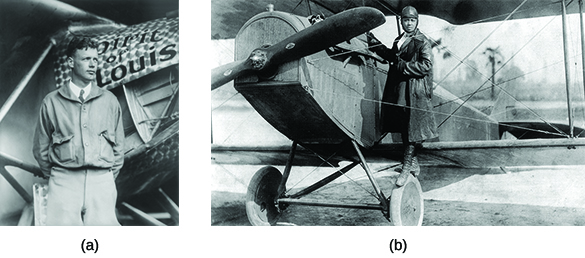
Lindbergh'south flying made him an international hero: the best-known American in the world. On his render, Americans greeted him with a ticker-tape parade—a commemoration in which shredded paper thrown from surrounding buildings creates a festive, flurry outcome. His flight, which he completed in the monoplane Spirit of St. Louis, seemed like a triumph of individualism in mod mass society and exemplified Americans' power to conquer the air with new technology. Following his success, the small airline industry began to flower, fully coming into its own in the 1930s, every bit companies like Boeing and Ford developed airplanes designed specifically for passenger air send. As technologies in engine and passenger compartment design improved, air travel became more popular. In 1934, the number of U.Due south. domestic air passengers was just over 450,000 annually. Past the end of the decade, that number had increased to nearly ii million.
Technological innovation influenced more than only transportation. Equally admission to electricity became more common and the electric motor was made more than efficient, inventors began to churn out new and more complex household appliances. Newly adult innovations like radios, phonographs, vacuum cleaners, washing machines, and refrigerators emerged on the market during this menstruum. While expensive, new consumer-purchasing innovations like store credit and installment plans made them available to a larger segment of the population. Many of these devices promised to give women—who continued to have master responsibility for housework—more opportunities to step out of the abode and aggrandize their horizons. Ironically, however, these labor-saving devices tended to increase the workload for women by raising the standards of domestic piece of work. With the aid of these tools, women ended up cleaning more frequently, washing more often, and cooking more elaborate meals rather than gaining spare time.
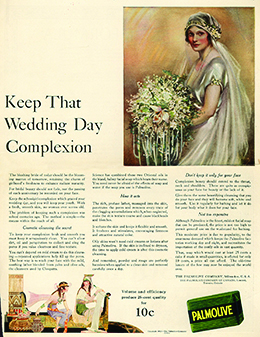
Despite the fact that the promise of more leisure time went largely unfulfilled, the lure of technology as the gateway to a more relaxed lifestyle endured. This enduring dream was a testament to the influence of another growing manufacture: advertizement. The mass consumption of cars, household appliances, ready-to-wear clothing, and candy foods depended heavily on the work of advertisers. Magazines like Ladies' Home Journal and The Saturday Evening Post became vehicles to connect advertisers with centre-class consumers. Colorful and occasionally provocative print advertisements busy the pages of these publications and became a staple in American popular culture ([link]).
This advertisement for Palmolive soap, which appeared in Ladies' Home Periodical in 1922, claimed that the soap's "moderate price is due to popularity, to the enormous demand which keeps Palmolive factories working day and night" and so "the former-fourth dimension luxury of the few may now exist enjoyed the world over."
The course of the advertisements, however, was not new. These colorful print ads were merely the modernistic incarnations of an ad strategy that went back to the nineteenth century. The new medium for advertisers in the 1920s, the ane that would reach out to consumers in radically new and innovative ways, was radio.
THE Ability OF RADIO AND THE WORLD OF SPORTS
Subsequently being introduced during Globe War I, radios became a common characteristic in American homes of the 1920s. Hundreds of radio stations popped upward over the decade. These stations developed and broadcasted news, serial stories, and political speeches. Much like print media, advertising space was interspersed with entertainment. Still, dissimilar magazines and newspapers, advertisers did not take to depend on the agile participation of consumers: Advertisers could accomplish out to anyone within listening altitude of the radio. On the other hand, their broader audition meant that they had to be more than conservative and conscientious non to offend anyone.

Listen to a recording of a broadcast of the "WLS Showboat: "The Floating Palace of Wonder," a multifariousness testify from WLS Chicago, a radio station run by Sears Roebuck and Co. What does the prune tell you about the entertainment of the 1920s?
The ability of radio further sped up the processes of nationalization and homogenization that were previously begun with the broad distribution of newspapers fabricated possible past railroads and telegraphs. Far more finer than these print media, however, radio created and pumped out American culture onto the airwaves and into the homes of families effectually the land. Syndicated radio programs like Amos 'n' Andy, which began in the tardily 1920s, entertained listeners around the country—in the case of the popular Amos 'northward' Andy, it did so with racial stereotypes almost African Americans familiar from minstrel shows of the previous century. No longer were small corners of the country separated by their access to information. With the radio, Americans from declension to coast could listen to exactly the same programming. This had the upshot of smoothing out regional differences in dialect, linguistic communication, music, and even consumer taste.
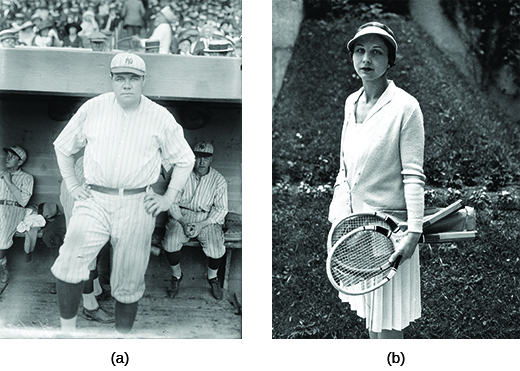
Radio too transformed how Americans enjoyed sports. The introduction of play-past-play descriptions of sporting events broadcast over the radio brought sports amusement right into the homes of millions. Radio also helped to popularize sports figures and their accomplishments. Jim Thorpe, who grew up in the Sac and Fox Nation in Oklahoma, was known as one of the all-time athletes in the world: He medaled in the 1912 Olympic Games, played Major League Baseball, and was one of the founding members of the National Football League. Other sports superstars were soon household names. In 1926, Gertrude Ederle became the outset adult female to swim the English Channel. Helen Wills dominated women's lawn tennis, winning Wimbledon eight times in the late 1920s ([link]), whereas "Big Bill" Tilden won the national singles title every twelvemonth from 1920 to 1925. In football game, Harold "Red" Grange played for the Academy of Illinois, averaging over x yards per carry during his college career. The biggest star of all was the "Sultan of Swat," Babe Ruth, who became America's offset baseball hero ([link]). He changed the game of baseball from a low-scoring one dominated by pitchers to ane where his hitting became famous. By 1923, nigh pitchers intentionally walked him. In 1924, he hit 60 homeruns.
Babe Ruth (a) led the New York Yankees to iv Earth Series championships. In this 1921 photograph, he stands exterior of the New York Yankees dugout. Helen Wills (b) won a total of xxx-ane G Slam titles in her career, including eight singles titles at Wimbledon from 1927 to 1938. (credit a: modification of work by Library of Congress)
section-summary
For many middle-course Americans, the 1920s was a decade of unprecedented prosperity. Rising earnings generated more disposable income for the consumption of entertainment, leisure, and consumer goods. This new wealth coincided with and fueled technological innovations, resulting in the booming popularity of entertainments similar movies, sports, and radio programs. Henry Ford's advances in assembly-line efficiency created a truly affordable auto, making automobile ownership a possibility for many Americans. Ad became as big an industry equally the manufactured appurtenances that advertisers represented, and many families relied on new forms of credit to increase their consumption levels and strive for a new American standard of living.
Review Questions
Which of the following films released in 1927 was the starting time successful talking movement motion picture?
- The Clansman
- The Cracking Gatsby
- The Jazz Singer
- The Birth of a Nation
C
The popularization of ________ expanded the communications and sports industries.
- radios
- talkies
- the Model T
- airplanes
A
Who was the commencement person to fly solo beyond the Atlantic Bounding main?
- Orville Wright
- Jim Thorpe
- Charlie Chaplin
- Charles Lindbergh
D
How did Henry Ford transform the motorcar manufacture?
Henry Ford revolutionized the automobile manufacture past making the car affordable to the average person. In social club to reach this, he refused to let workers to unionize, instituted an eight-hour workday, raised workers' wages, promoted equal pay for black and white workers and for women; and used assembly lines to facilitate production. The machine thus became a symbol of centre-class life, rather than a luxury good available only to the wealthy.
Glossary
- Hollywood
- a small town north of Los Angeles, California, whose reliable sunshine and cheaper production costs attracted filmmakers and producers starting in the 1910s; past the 1920s, Hollywood was the center of American movie product with 5 movie studios dominating the industry
- Model T
- the first motorcar produced by the Ford Motor Visitor that took reward of the economies of calibration provided by associates-line production and was therefore affordable to a large segment of the population
- moving assembly line
- a manufacturing process that allowed workers to stay in 1 place every bit the work came to them

Mass Entertainment In The 1920s,
Source: https://pressbooks-dev.oer.hawaii.edu/ushistory/chapter/prosperity-and-the-production-of-popular-entertainment/
Posted by: dewittnaal1948.blogspot.com
0 Response to "Mass Entertainment In The 1920s"
Post a Comment