

Are Chickens Cold Blooded Animals
Laying hens are warm blooded (homeothermic) animals, that means that they can maintain their body temperature constant, i.e. within a sure range. On boilerplate, the body temperature of salubrious chickens falls within the range of 40 - 42°C. The thermal neutral zone for developed laying hens ranges from 18 °C to 24 °C (ambient temperatures), this means that inside this temperature range the birds do not need to alter their metabolism to stay warm or to get rid of the oestrus. For newborn chickens it takes some time before their heat regulating mechanisms can office normally, that is the main reason why the young birds demand college ambience temperatures during the first weeks of their life. Directly linked to that is their lack of body reserves (particularly fat), and the ratio of the surface surface area vs. their bodyweight is unfavorable, resulting in oestrus losses.
When house temperatures are not within the thermal neutral zone, chickens have several characteristics that enable them to keep their body temperature constant without the need to produce extra heat. These characteristics include:
- Feathers, they have an insulating upshot and assist to prevent the chickens from excessive heat loss
- Tissue insulation, subcutaneous fatty will allow the hens to drib their peel temperature whilst not negatively affecting their body temperature.
- Adapt the claret flow through the skin (including combs and wattles), chickens can regulate the widening and contraction of their claret vessels. In order to lose more heat, the blood flow volition be enlarged
- Huddle together to minimize the loss of heat
- Ability to increasing the body surface to lose more heat
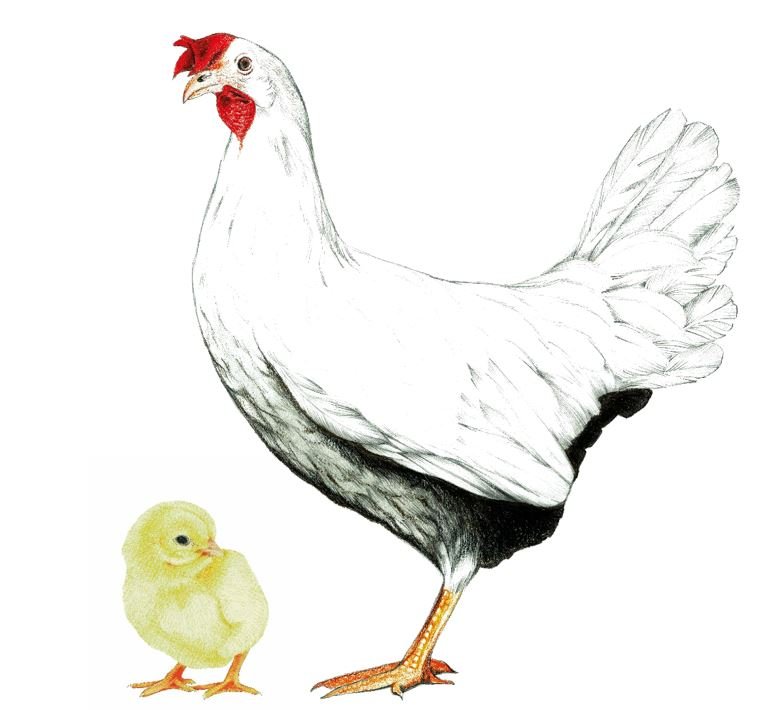
Go on in listen: a young chick has relatively the largest contact surface with the surrounding air, therefore they can cool off much quicker compared to an developed laying hen.
The Five means to keep cool
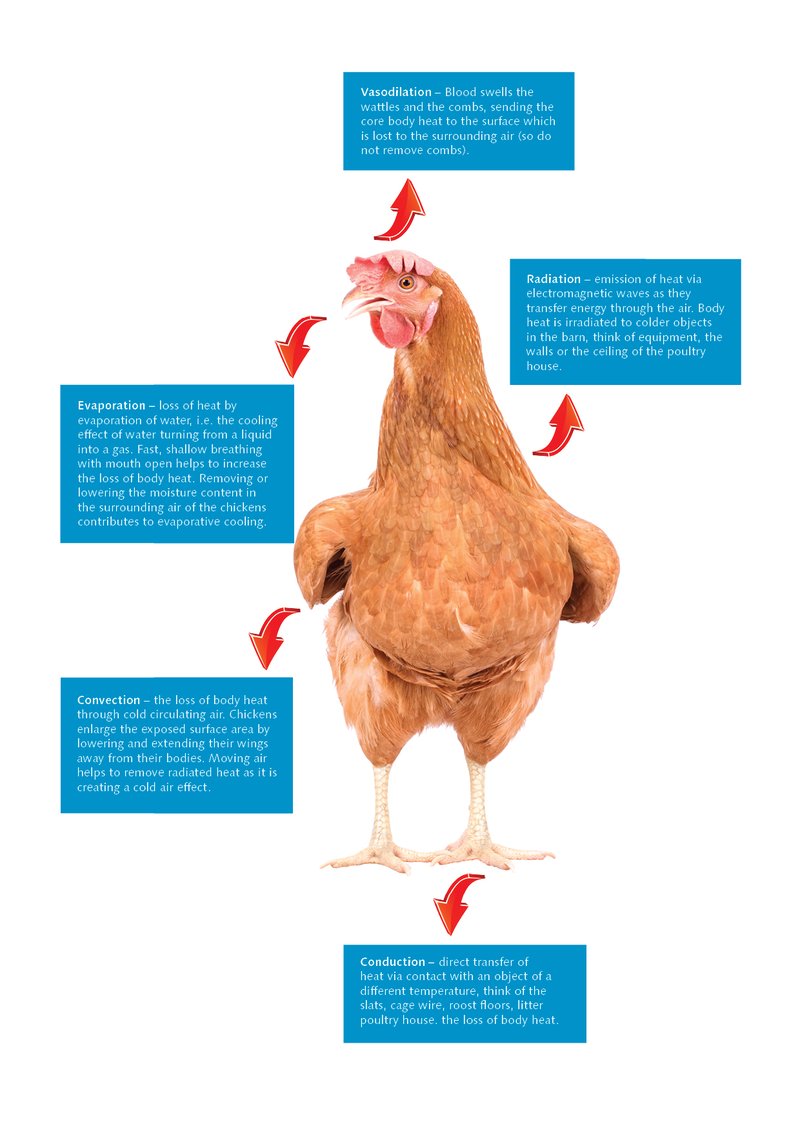
Chickens regulate their torso temperature via their hypothalamus, which is a office of the brain that is comparable to a thermostat. Heat emission and heat retention is largely influenced by the contraction and widening of the blood vessels and the speed of respiration. Chickens practise non have sweat glands; therefore, they are not able to lose their heat via transpiration. They practise are able to lose their heat themselves via different pathways:
- Radiation
- Convection
- Conduction
- Evaporation
- Vasodilation
Radiation, convection, and conduction are all three related to sensible heat loss. Sensible heat is the energy required to change the temperature of a substance with no alter of phases. The loss of trunk oestrus comes from the contact with the cooler surrounding air, that absorbs the heat of the birds. Chickens are ordinarily able to maintain their normal body temperature of 40 - 42°C via sensible heat loss when the environmental temperature falls within their thermal neutral zone of 18 – 24°C. When the barn temperature rises higher up 25°C the efficiency of sensible heat loss is going down, and at 35°C information technology has hardly any event unless the relative humidity is depression. Direction plays a vital part in maintaining your chickens trunk temperature within their condolement zone.
Chickens can lose oestrus to the surrounding air, this is chosen convection or radiation, which permits the transfer of body heat to the air. Proper ventilation, which results in faster air motion inside the poultry house, volition result in ameliorate oestrus loss due to convection. Equally long equally the ambient air temperature is colder than the chicks' torso temperature the aforementioned volition work. Therefor cooling the incoming air will result in improved radiation. But keep in mind, the smaller the divergence between the body temperature of the chickens and the ambience temperature gets, the lower the possibility for proper heat loss gets. This is also true for humidity, the amount of moisture that the birds tin can evaporate becomes smaller when the humidity gets up.
Side by side to panting, chickens can increase their heat loss past extending their wings and putting up their feathers (they become fluffy). This will allow more air to circulate near the body (particularly the skin), and it increases the contact surface with the surrounding air to expel the heat. Equally mentioned earlier, laying hens can regulate their blood circulation to lose heat. They can increase blood circulation in their rummage, wattles, and pare to lose more oestrus to the cooler surrounding air (called vasodilation). Always reconsider the aforementioned prior to request for dubbed roosters as it can negatively influence the bird's wellness and welfare nether situations of heat stress.
The above mechanisms can only piece of work when management is properly adopted to the needs of the laying hens. Changes in water and feed management, like adding vitamins or buffers tin impact about 15% of the estrus stress, much larger bear upon (85%) tin can exist made via managing the climate in the poultry house via ventilation. As this will better help your flocks in dealing with too high and also cold temperatures via the direction of the flock.
Estrus stress occurs when the chickens' core body temperature increases to fatal temperatures because of poor rut loss. Chickens are not that well capable to cope with high torso temperatures, therefor astringent heat stress tin cause increased bloodshed of the flock. Both temperature and the relative humidity play a crucial part in the occurrence of heat stress. Information technology is central to measure an monitor both carefully.
As laying hens cannot sweat, they use evaporation (latent heat) to stabilize their trunk temperature by increasing their respiration rate. The latent heat of evaporation is the oestrus required to modify ware into water vapor. The water vapor is taking abroad the heat from the hens' body. This behavior is better known equally "panting". Panting tin only be effective when the relative ecology humidity is not as well high. The evaporation of 1 gram of h2o results in a heat loss of over 500 calories! Losing oestrus besides comes with a cost, as the chickens need to expend their free energy in trying to maintain their body temperature below 42.5°C. as information technology is pretty hard to recoup for this higher energy requirement via their nutrition, you'll probable come across a reduction in growth, body weight and production performance.
Keep in listen: chickens do not have sweat glands, therefor they are non able to lose their heat via transpiration. When a chicken wants to cool down, she volition start panting. Via panting with her beak open (y'all can run into the birds' throat rapidly moving backwards and forrard) the bird is able to get rid of the backlog heat every bit the panting enables moisture to evaporate through the airways. Next to the panting, the birds will hold their wings out slightly from their bodies and they raise their feathers to maximize the skin contact with air to miscarry the heat.
As rut stress is already a stress on its ain, information technology is important not to stress your birds any further. Nosotros have listed some practical tips and tricks below, often easy to implement and at a low price.
- When chick handling is required (vaccination, transfer, sorting, depopulation) it is advised to do this in the early mornings.
- When transporting the chickens, place fewer birds in crates and place empty crates in the truck to enhance ventilation during transport. Effort to minimize the bulldoze and drive during late dark and early morning
- Endeavor to avert disturbing the laying hens during the hottest role of the day, disturbance results in even more than stress to the chickens
- Respect the stocking densities carefully, both in cage and floor housing systems. Too high stocking densities could reduce the effectiveness of ventilation and creates competition for h2o and feed. In general, cage chickens are more susceptible to heat stress as they are non able to find themselves a libation identify.
The relationship between heat stress and eggshell quality
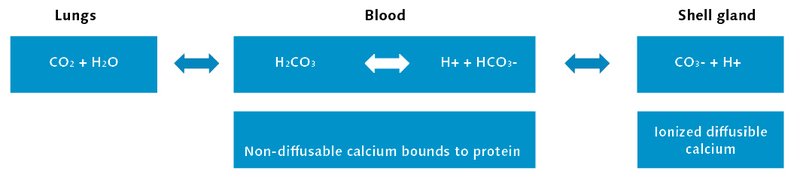
As a result of heat stress, the laying hens body temperature can rise above the 42.five°C. As a result of panting (hyperventilation), the laying hens will loose extreme amounts of CO2. This farthermost loss will cause a rising in the pH of the claret, i.e., the blood volition become alkalotic and causing metabolic alkalosis. This will cause depression concentrations of blood calcium. Every bit the claret pH increases, blood transport proteins, such as calbindin, become more ionized into anions. This causes the free calcium present in the blood to bind more strongly with the calbindin, resulting in less availability of calcium and phosphor for the eggshell germination and reduced secretion of calcium and carbonate by the shell gland.
Tip: adding Vitamin C, Vitamin Eastward and H₂CO₃ to the diets tin can aid to prevent the claret from becoming alkalotic.

Are Chickens Cold Blooded Animals,
Source: https://layinghens.hendrix-genetics.com/en/articles/understanding-chicken/#:~:text=Laying%20hens%20are%20warm%20blooded,of%2040%20%2D%2042%C2%B0C.
Posted by: dewittnaal1948.blogspot.com
0 Response to "Are Chickens Cold Blooded Animals"
Post a Comment