

How To Hold A Phone While Taking A Picture
When taking pictures, one of the biggest frustrations one can experience is camera shake, which often happens as a result of the way the camera is held at lower shutter speeds. Properly hand-belongings a camera can drastically reduce human being-induced camera shake and result in many more than sharp images and keepers. In this article, we will discuss a few dissimilar means to agree a camera, which volition hopefully reduce and potentially fifty-fifty eliminate unwanted blurry images when y'all are shooting in the field.
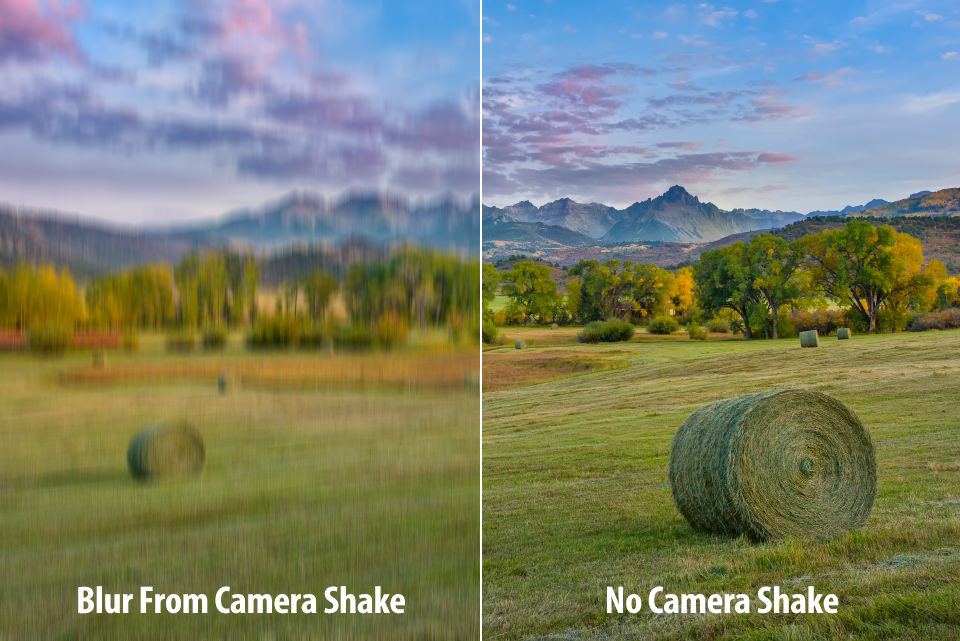
As y'all may already know, many cameras today come up with specific features to assist avoid the dreaded camera shake. Some cameras have paradigm stabilization built direct into the photographic camera sensor, while others might have image stabilization bachelor on the lens, and some even combine photographic camera and lens stabilization to become the all-time of the ii worlds. In add-on, many modern cameras today come with the ability to automatically control the camera ISO (often referred to as "Car ISO") in order to go on the shutter speed fast enough for the focal length 1 is using (for more details see reciprocal dominion). While using such features can certainly aid in reducing camera milkshake, information technology does non hurt to take additional measures to larn how to properly hand-hold a camera and that'southward exactly what we are going to do side by side!
Tabular array of Contents
ane) What is Camera Shake?
Camera milk shake occurs when the camera is unintentionally moved while the shutter speed of the photographic camera is too low to capture a perfectly still image. The resulting epitome either looks blurry, or shows traces of "dragging" of the subjects, where multiple outlines could be visible around the subjects. Photographic camera milk shake due to tiresome shutter speed typically takes place in low-light conditions when there is non enough light for the camera to yield a sufficiently bright epitome, or when exposure settings are set up incorrectly. For instance, information technology is frequently needed to open lens discontinuity as much every bit possible and increase camera ISO when shooting in indoor environments, because the amount of ambient light is likewise low. And when there is non enough light, the camera's shutter speed must be slowed down to yield a properly exposed epitome (to understand the relationship betwixt the three exposure variables, please see our article on Exposure Triangle).
two) The Human relationship Between Shutter Speed and Focal Length: The Reciprocal Rule
If the shutter speed is too low for a given focal length of the lens, even slight movements to the camera can consequence in camera shake. It is of import to sympathize the relationship between shutter speed and focal length in photography – as focal length increases, one has to simultaneously increment the shutter speed in order to avoid mistiness caused by from camera shake. Take a look at the below illustration:
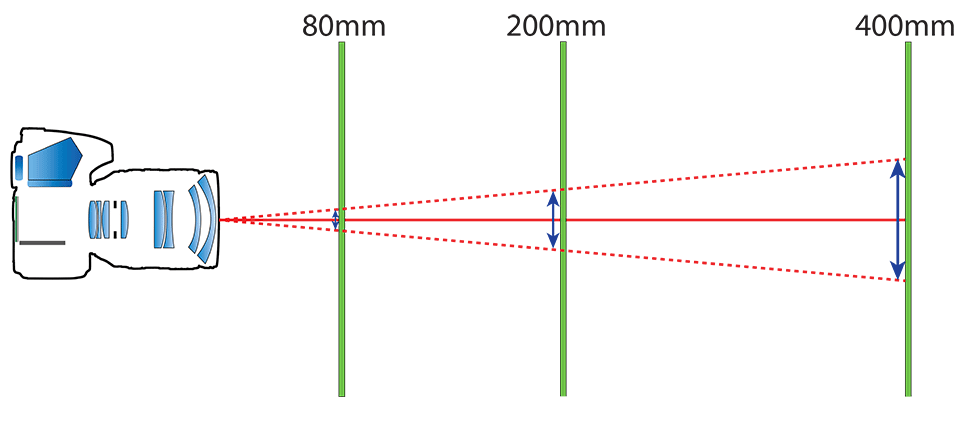
As you tin encounter, the longer the focal length of a lens, the bigger the likelihood of seeing camera shake, since every movement is so much more amplified. If one understands this relationship well in practice, information technology is possible to avoid camera shake by keeping the shutter speed equal to the focal length of a lens, which is known equally the Reciprocal Rule (I highly recommend that you give this commodity a read, since everything is explained in detail there).
Delight go on in mind that the reciprocal rule is only a guideline to avert camera shake – if i does a poor task at mitt-property a camera, much faster shutter speeds might be required in society to keep blur out of images. Therefore, it is important to know how to properly paw-agree a photographic camera!
three) Hand-Holding Techniques
Permit'southward talk most a few paw-holding techniques that will help you lot eliminating camera milk shake and yielding sharp images. Here is a video clip excerpt from one of our complimentary courses, where John and I cover a few different mitt-holding techniques that help avoid photographic camera shake:
As you can see, y'all can have a few simple steps to make sure that your camera is steady on your hands.
3.1) How to Hold a Photographic camera in Standing Position
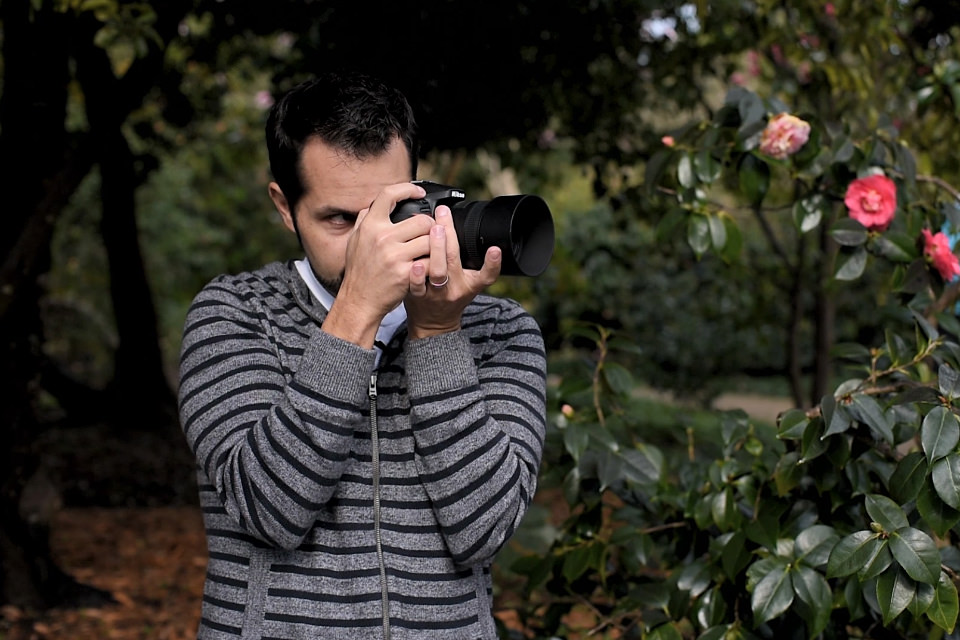
When you are in a regular standing position, use the below tips to avoid photographic camera shake:
- Place your anxiety perpendicular to your subject: when hand-property a camera, yous typically take more than rest when standing perpendicular to your subject, since there is less dorsum and along movement of your body compared to when standing parallel to your subject. If you have ever shot with an automatic rifle, you know that this standing position works very well, since at that place is quite a bit of recoil caused by the gun and standing sideways makes it easier to absorb each shot. So if y'all apply the same principle to shooting with a camera, it will surely work!
- Push your elbows into your sides: you want to avoid being in a "flapping" position with your elbows, because they will constantly move, causing your hands to move also. Instead, tuck your elbows in and residue them against your torso. Your torso will serve as a resting spot for your elbows, which will not only help stabilize your easily, merely too allow them rest better when holding heavy gear.
- Concord camera at balance point: with every camera and lens combination, there is always going to be a point at which the camera setup won't be neither forepart nor back-heavy. If you put your hand right at this point and let the camera rest on it, y'all will achieve good residuum, which will make it easier to hand-agree the camera for extended periods of time, since you don't take to fight the weight on either side of the paw.
- Concur photographic camera to your face: while some of united states might prefer to use the dorsum of the camera screen to frame images, shooting with your arms extended is e'er going to introduce more camera shake. If your camera has a viewfinder, y'all will find that property the camera to your face up will make it easier to stabilize the setup.
- Push the camera to your head: once your arms are close to your body and fully tucked in, you can help stabilize the camera fifty-fifty more past slightly pushing the camera confronting your head.
- Bonus tip – breathe out right earlier squeezing the shutter release: Again, this trick is known to those who accept served in the military or have experience shooting long-range rifles. If you lot slowly exhale out correct earlier squeezing the shutter release, you have a college adventure of fugitive camera milkshake, considering your body is not moving as much as it does when yous heavily exhale.
Hither is John showing how to have the above into practice:
3.ii) How to Hold a Photographic camera With a Grip
If your camera is equipped with a grip, you can take advantage of a very good technique that is known as the "Joe McNally Grip". This technique was revealed past one of my almost favorite portrait photographers Joe McNally many years ago, where he demonstrated the technique of manus-holding the camera with a grip on his shoulder. This technique works really well, because your shoulders are typically more stable than your easily, so if you lot rest your camera on 1 of your shoulders, you can achieve really show shutter speeds without introducing photographic camera milkshake. Hither is what y'all demand to do:
- You need a camera with a grip: this one is a must, because a regular camera is also brusk for you to be able to rest it on your shoulder while you lot are trying to wait through the viewfinder. The grip solves this problem.
- Rest the left corner of the grip on your left shoulder: put the corner of the grip to a comfortable area of your shoulder. I personally adopt putting the corner of the grip on the softer front end side of my left shoulder, just y'all should experiment and see where the photographic camera rests comfortably for you.
- Await through the viewfinder with your left centre: if you are used to look through the viewfinder with your correct eye this one might take some time to become used to.
- Wrap your left hand over your correct hand: you don't want your left hand just dangling off your body – yous want to wrap it over your right hand, which helps push button the photographic camera further into your shoulder for extra stability.
- Push the camera to your head and breathe out: aforementioned tips as the previous technique.
Here is how it should look from the side:
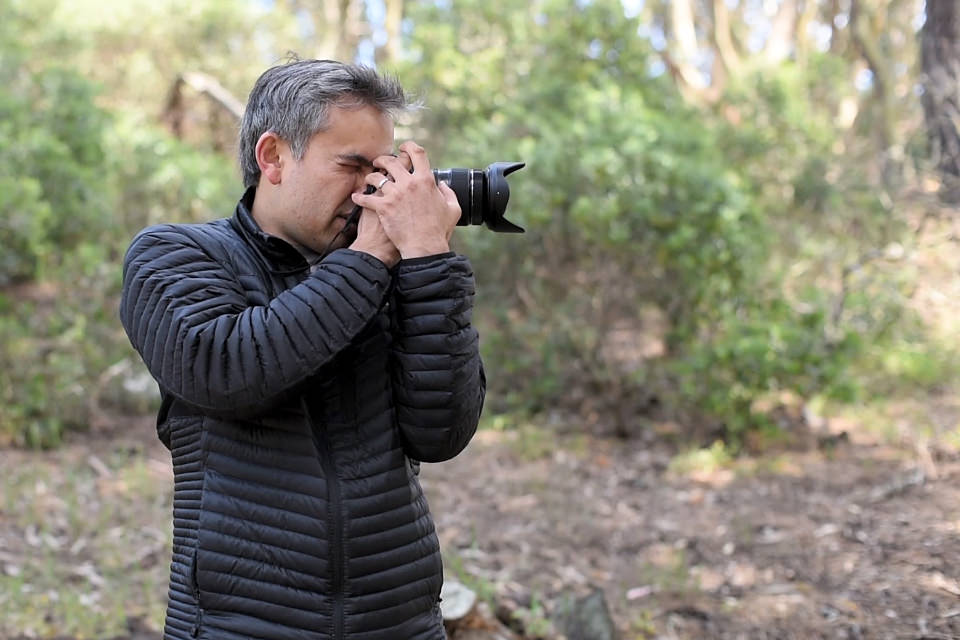
I personally constitute this technique to be very useful in situations where I accept to use very tiresome shutter speeds without having to increase ISO or open my aperture. If yous do everything correct, you should be able to achieve ridiculously slow shutter speeds – I accept once managed to take a full second exposure without camera shake with the Joe McNally grip!
three.three) How to Hold Telephoto Lenses
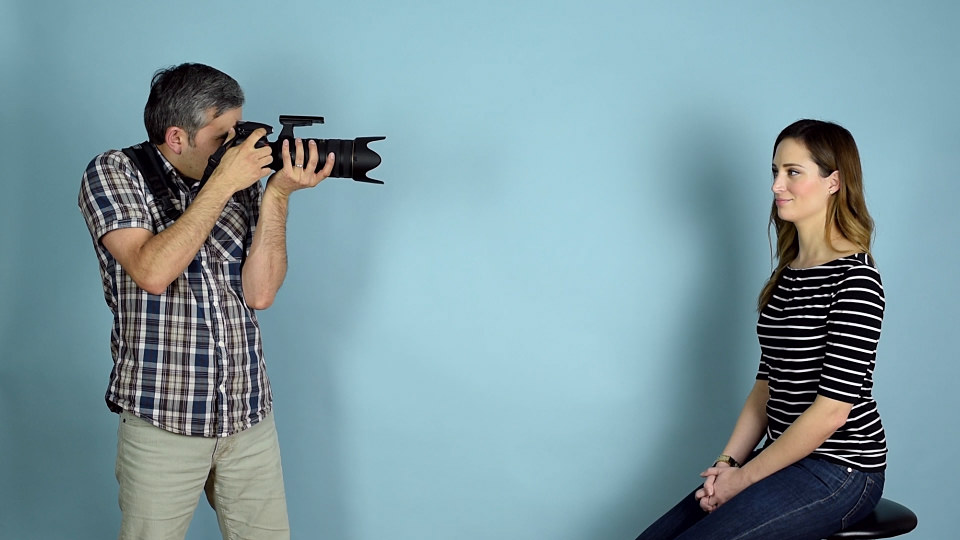
The technique for manus-holding telephoto lenses can exist slightly unlike, because there is much more weight on the front of the camera. For the most function though, you will be doing like things as when holding a regular setup:
- Detach or reverse lens foot: heavy telephoto lenses typically come with the own tripod anxiety, because they are too heavy to be dangling off the photographic camera mount. I personally never found it comfortable to hand-hold lenses by holding them by the tripod feet, especially when shooting for extended periods of time (try doing that on a full day wedding!). Non only will information technology cause the camera to move left and right, but it will also bruise up your easily. Instead, either remove the tripod foot completely (if you don't use information technology), or reverse the lens foot and so that information technology faces up.
- Detect the best balance signal: with the lens human foot reversed, you can comfortably find the area where the lens and camera perfectly balance on your manus.
- Place your feet perpendicular to your subject: same as above, but becomes even more than of import with longer telephoto lenses, since the setup is heavier.
- Button your elbows into your sides: once again, you want your hands tucked in tight to your body to avert photographic camera milk shake.
- Push button the camera to your head and breathe out: same tips equally the previous technique.
I have been using this technique for many years when shooting with 70-200mm and longer telephoto lenses and it has worked really well for me. Here is yours truly demonstrating the technique in the video:
3.4) Stabilization past Leaning
Another great manner to significantly reduce photographic camera milkshake when hand-holding a lens is to discover a stable object that you can lean against, such equally a tree, a wall or a machine. This completely eliminates the potential to rock back and forth when taking a moving picture, thus allowing i to shoot at very depression shutter speeds. Not much to add together to this technique – make sure that y'all yet accept your easily tucked in, with the camera pushing against your head for actress stability. Stabilizing your breathing will also help in getting a sharper paradigm, and then give information technology a try!
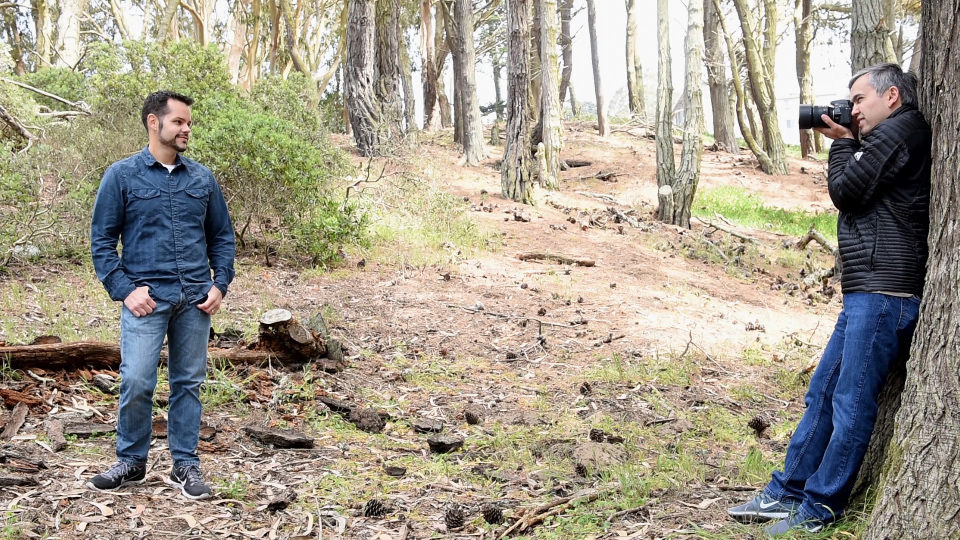
In the in a higher place image, I am leaning against a tree while photographing John with an 85mm lens at around 1/50th of a 2nd, which worked out keen to get a very sharp prototype.
3.five) How to Hand-Hold Photographic camera While Sitting
Ane technique that we did not cover in the video is how to hand-hold a camera while sitting on the footing. While many of us rarely utilise this technique, information technology can be very useful in exercise when photographing subjects from a lower bending, such equally when photographing children. In one case again, if y'all have weapon experience, you already know the best postures for proper hand-holding – either pushing your elbows against your knees while sitting while belongings the camera in the center, or using the kneeling position, with the left elbow resting on your left knee, while your right knee is on the ground. Both techniques piece of work really well, although many would probably adopt the kneeling position more than to the sitting position to continue clothes make clean.
4) Epitome Stabilization Considerations
Continue in mind that when shooting with cameras and lenses that have built-in image stabilization, the reciprocal rule and the techniques discussed above might apply slightly differently. First of all, paradigm stabilization can do a tremendous task in reducing photographic camera shake by compensating for dissimilar unwanted movements and motions, sometimes by upwardly to 3-4 stops, which is a lot! Then if y'all observe yourself struggling to take sharp images at depression shutter speeds and y'all have an image stabilization feature, brand sure to turn information technology on. By default, you should always have image stabilization turned on when shooting paw-held, unless your shutter speeds are so fast that y'all don't demand it (in some cases when using shutter speeds faster than the focal length of the lens, epitome stabilization might actually piece of work confronting you). Too, when shooting hand-held with telephoto lenses that have image stabilization, you lot should make sure to stabilize the setup first by half-pressing the shutter and letting image stabilization boot in for a 2d or 2 earlier taking a moving picture, every bit described in this article.
5) Dealing with Camera Shake on a Tripod
Although camera shake is commonly experienced when shooting hand-held, it can as well happen when shooting from a tripod, where such factors equally wind, tripod stability and shutter release by paw tin can crusade unwanted movements. We have already written a detailed guide on how to reduce photographic camera milkshake on a tripod, so please requite that commodity a read – there is enough of information there!
Since we as photographers always strive to capture precipitous photographs with plenty of detail, camera milkshake tin can be very frustrating to deal with, so I hope yous establish the above article useful. If you have whatever other tips to avert camera shake when hand-belongings lenses, delight permit united states of america know in the comments section below!

How To Hold A Phone While Taking A Picture,
Source: https://photographylife.com/how-to-hold-a-camera
Posted by: dewittnaal1948.blogspot.com
0 Response to "How To Hold A Phone While Taking A Picture"
Post a Comment